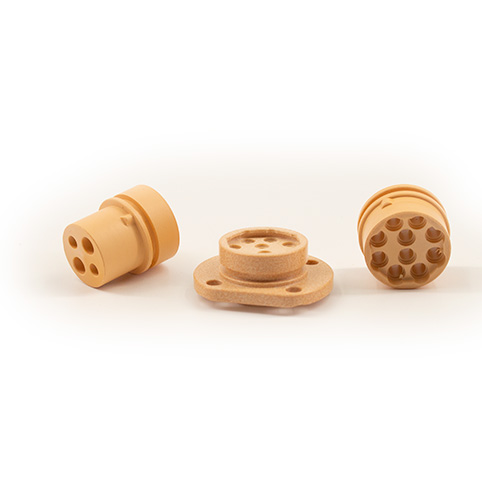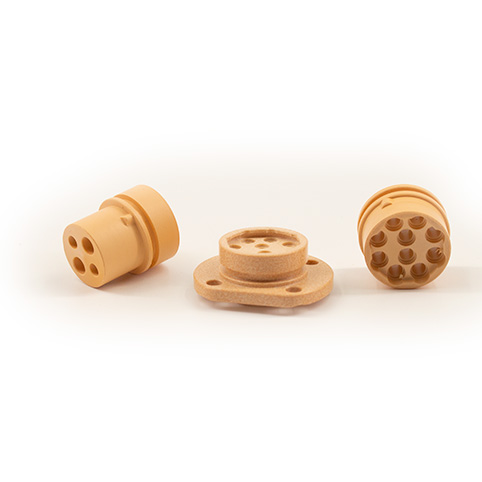
The material requirements and performance requirements for insulators of military standard (abbreviated as "military standard") connectors are usually determined in accordance with relevant military standards, such as MIL-DTL-38999 and others. The specific requirements are as follows:
Thermosetting Plastics: In the MIL-DTL-38999 series of military standard connectors, insulators often use thermosetting plastics. These materials have high mechanical strength, good heat resistance, and excellent molding performance, and can maintain stable performance in harsh environments.
Special Engineering Plastics: Insulators of some military standard connectors adopt special engineering plastics, such as Polyphenylene Sulfide (PPS) and Polyimide (PI). These materials possess excellent high-temperature resistance, chemical corrosion resistance, and electrical insulation performance.
Thermoplastic Plastics: In some specific application scenarios, high-performance thermoplastic plastics are also used, such as Liquid Crystal Polymer (LCP) and Polycyclohexylene Dimethylene Terephthalate (PCT). Such materials have good processability and electrical performance.
Polytetrafluoroethylene (PTFE): It has extremely low dielectric constant and dielectric loss tangent, as well as excellent temperature resistance and chemical resistance. It is often used in military standard connectors with extremely high requirements for electrical performance.
Insulation Resistance: According to MIL-DTL-38999, the insulation resistance of the insulator shall be ≥ 5000 MΩ under normal conditions and ≥ 100 MΩ under humid conditions, so as to ensure that the connector can effectively isolate electrical circuits and prevent leakage and short circuits in different environments.
Withstand Voltage: Depending on the operating voltage and service environment, the insulator of the military standard connector must be able to withstand a certain voltage without breakdown. For example, in MIL-DTL-38999, the withstand voltage at sea level can reach different levels such as 1300 V, 1800 V, and 2300 V.
Dielectric Performance: It is required that the dielectric constant and dielectric loss tangent of the insulator remain stable under different frequencies and temperatures, so as to reduce losses and interference during signal transmission.
Vibration and Shock Resistance: Military standard connectors must be able to withstand vibration and shock with a certain frequency and acceleration. For instance, GJB599 stipulates that connectors shall withstand random vibration with a frequency range of 100-1000 Hz and a power spectral density of 1 g²/Hz, as well as shock with a 3 ms half-sine wave and a peak acceleration of 300 g; GJB2889 stipulates that connectors shall withstand sinusoidal vibration with a frequency range of 10-2000 Hz and an acceleration of 196 m/s².
Tensile Strength and Flexural Strength: The insulator shall have sufficient tensile strength and flexural strength to prevent cracking and deformation during installation, plugging, and other operations. Generally, the tensile strength is required to be ≥ 60 MPa, and the flexural strength ≥ 80 MPa.
Temperature Resistance Range: Military standard connectors have a wide operating temperature range. For example, the temperature resistance range of Series II connectors in GJB599 is -65℃ to +200℃, which can meet the service requirements under different ambient temperatures.
Moisture Resistance and Salt Spray Resistance: The insulator must have good moisture resistance and salt spray resistance to prevent problems such as degradation of insulation performance and metal corrosion in humid, salt spray, and other environments. For example, MIL-DTL-38999 stipulates that Class B connectors shall pass a 500-hour salt spray resistance test.
Chemical Resistance: It shall be able to resist the erosion of various chemical substances, such as fuel oil, lubricating oil, and solvents, to ensure that its performance does not change significantly when in contact with these chemical substances.